$8.40
Original: $24.00
-65%The Girls—
$24.00
$8.40The Story
With “much humor” and “awareness of family dynamics” this classic novel “stands as an enduring portrait of women torn between duty and self-fulfillment”(Publishers Weekly).
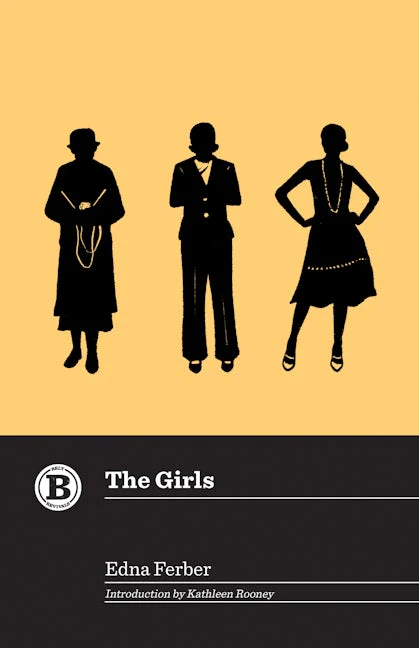
First published in 1921, Edna Ferber’s The Girls revolves around the “three Charlottes” of the Thrift family—Great-Aunt Charlotte, her niece Lottie, and Lottie’s niece Charley. All single “old maids,” as the narrator describes them, their lives weave together as they deal with issues involving money, work, friendship, family, and love as they strive to join Chicago’s growing middle class in the early twentieth century.
With a historic span that travels from the Civil War to World War I, Ferber highlights how the three generations of Charlottes lead very different lives. But we also see the ways their experiences rhyme with one another and how, despite the social advances in America, as Kathleen Rooney writes in her introduction, all three have to confront “a sexist and claustrophobic societal atmosphere in which any little act of self-assertion can feel like a leap from a precipice.”
Told through Ferber’s assured and generous style, and full of her signature strong female characters, The Girls is an American classic.
“This is one of those books that nails setting and character so well that plot is mostly beside the point. . . . Ferber splits the difference with clearer prose and keener insight than [Sister Carrie author Theodore] Dreiser managed, while incorporating some of the same dry humor that [Babbitt author Sinclair] Lewis used to describe midwestern strivers.” —Dmitry Samarov, Chicago Reader
“Written with such verve and insight that it could be a piece of historical fiction produced last week.” —Patrick T. Reardon, Third Coast Review
First published in 1921, Edna Ferber’s The Girls revolves around the “three Charlottes” of the Thrift family—Great-Aunt Charlotte, her niece Lottie, and Lottie’s niece Charley. All single “old maids,” as the narrator describes them, their lives weave together as they deal with issues involving money, work, friendship, family, and love as they strive to join Chicago’s growing middle class in the early twentieth century.
With a historic span that travels from the Civil War to World War I, Ferber highlights how the three generations of Charlottes lead very different lives. But we also see the ways their experiences rhyme with one another and how, despite the social advances in America, as Kathleen Rooney writes in her introduction, all three have to confront “a sexist and claustrophobic societal atmosphere in which any little act of self-assertion can feel like a leap from a precipice.”
Told through Ferber’s assured and generous style, and full of her signature strong female characters, The Girls is an American classic.
“This is one of those books that nails setting and character so well that plot is mostly beside the point. . . . Ferber splits the difference with clearer prose and keener insight than [Sister Carrie author Theodore] Dreiser managed, while incorporating some of the same dry humor that [Babbitt author Sinclair] Lewis used to describe midwestern strivers.” —Dmitry Samarov, Chicago Reader
“Written with such verve and insight that it could be a piece of historical fiction produced last week.” —Patrick T. Reardon, Third Coast Review
Description
With “much humor” and “awareness of family dynamics” this classic novel “stands as an enduring portrait of women torn between duty and self-fulfillment”(Publishers Weekly).
First published in 1921, Edna Ferber’s The Girls revolves around the “three Charlottes” of the Thrift family—Great-Aunt Charlotte, her niece Lottie, and Lottie’s niece Charley. All single “old maids,” as the narrator describes them, their lives weave together as they deal with issues involving money, work, friendship, family, and love as they strive to join Chicago’s growing middle class in the early twentieth century.
With a historic span that travels from the Civil War to World War I, Ferber highlights how the three generations of Charlottes lead very different lives. But we also see the ways their experiences rhyme with one another and how, despite the social advances in America, as Kathleen Rooney writes in her introduction, all three have to confront “a sexist and claustrophobic societal atmosphere in which any little act of self-assertion can feel like a leap from a precipice.”
Told through Ferber’s assured and generous style, and full of her signature strong female characters, The Girls is an American classic.
“This is one of those books that nails setting and character so well that plot is mostly beside the point. . . . Ferber splits the difference with clearer prose and keener insight than [Sister Carrie author Theodore] Dreiser managed, while incorporating some of the same dry humor that [Babbitt author Sinclair] Lewis used to describe midwestern strivers.” —Dmitry Samarov, Chicago Reader
“Written with such verve and insight that it could be a piece of historical fiction produced last week.” —Patrick T. Reardon, Third Coast Review
First published in 1921, Edna Ferber’s The Girls revolves around the “three Charlottes” of the Thrift family—Great-Aunt Charlotte, her niece Lottie, and Lottie’s niece Charley. All single “old maids,” as the narrator describes them, their lives weave together as they deal with issues involving money, work, friendship, family, and love as they strive to join Chicago’s growing middle class in the early twentieth century.
With a historic span that travels from the Civil War to World War I, Ferber highlights how the three generations of Charlottes lead very different lives. But we also see the ways their experiences rhyme with one another and how, despite the social advances in America, as Kathleen Rooney writes in her introduction, all three have to confront “a sexist and claustrophobic societal atmosphere in which any little act of self-assertion can feel like a leap from a precipice.”
Told through Ferber’s assured and generous style, and full of her signature strong female characters, The Girls is an American classic.
“This is one of those books that nails setting and character so well that plot is mostly beside the point. . . . Ferber splits the difference with clearer prose and keener insight than [Sister Carrie author Theodore] Dreiser managed, while incorporating some of the same dry humor that [Babbitt author Sinclair] Lewis used to describe midwestern strivers.” —Dmitry Samarov, Chicago Reader
“Written with such verve and insight that it could be a piece of historical fiction produced last week.” —Patrick T. Reardon, Third Coast Review